Market size and growth:
2025-2035
The
Bank Of America report anticipates that 65% of
humanoid robots will be used in households, 32%
in services, and 3% in industrial applications
by 2060. Other reports from companies such as
Goldman Sachs are much more bullish on
industrial adoption, with a 38 billion market
size projected by 2035.
Market intelligence firm S&S reports that
The Humanoid Robot Market was valued at USD 2.21
billion in 2023 and is expected to reach
USD 76.97 billion by 2032, growing at a CAGR of
48.36% over the forecast period 2024-2032.
Estimates for sector CAGR range from 16-50% over
the 2025-2035 period, with over 15 significant
companies with GPHR prototypes operational in
2025. Specific estimates for unit sales range
from 1.4M to 10M units/year by 2035, with CAGR
progressions indicating the possibility of much
higher unit sales.
Bank of America analysts predict that
General-Purpose Humanoid Robot (GPHR)
development will accelerate rapidly, with global
annual sales reaching 1 million units by 2030
and 3 billion humanoid robots in operation by
2060.
Estimate Categories:
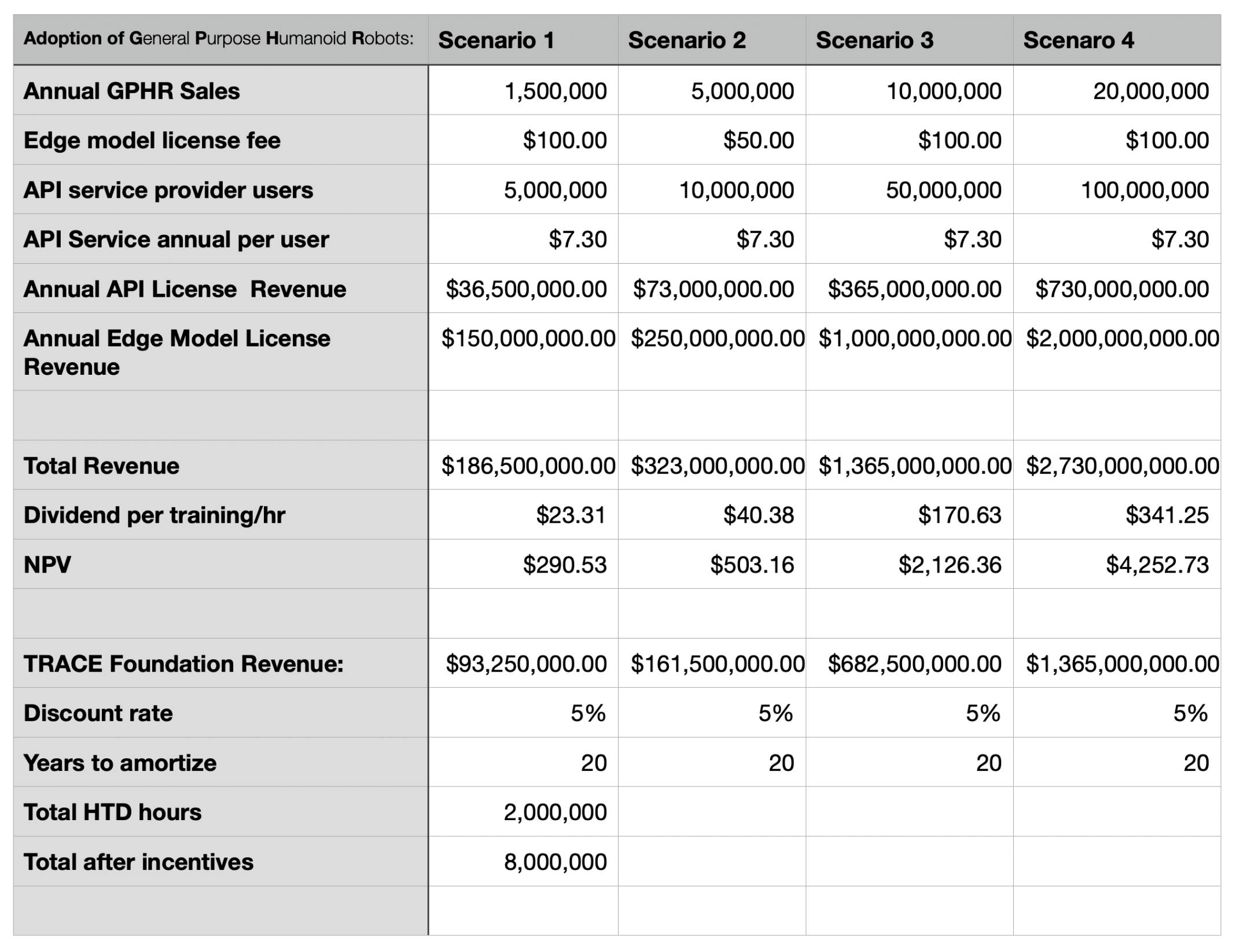
API
Pricing:
Estimated end-user cost for API usage $0.5 - $1
per day paid by user to API provider based on
0.5m tokens daily usage (this earns TRACE
$7.30 / year per API calling robot)
Scenaro 4: Exceptionally high growth
estimate (this level is not anticipated,
and no projections are based on this level of
adoption) - 20M unit sales at $16,000 each with
onboard edge models, earning TRACE $100
per unit sold—100 M robots using API service
providers.
Scenario 3: High-end 2035 market estimate (used
as the high end for projected earnings): 10M
unit sales at $16,000 each with onboard edge
models, earning TRACE $100 per unit
sold—50 M robots using API service providers.
Scenario 2: Low-end 2035 market estimate: 5M
unit sales at $5,000 each with onboard edge
models, earning TRACE $50 per unit
sold—10 M robots using API service providers.
Scenario 1: Pessimistic growth outlook (used as
the low end for projected earnings): 1.5M unit
sales at $26,000 each with onboard edge models,
earning TRACE $100 per unit sold—5M
robots using API service providers.
Sources:
Goldman Sachs
(TAM revised 6x from $6B to $38B by 2035; shipment forecast 4x to 1.4M units)
Citi Global
Insights (CNBC)
(1.3B robots by 2035; $15K humanoid pays back in under 4 weeks vs. $41/hr worker)
McKinsey
Global Institute
(57% of US work hours automatable; $2.9 trillion economic value)
Bank Of
America
(1M units/year by 2030; 3B robots by 2060)
(Forbes)
Morgan
Stanley (CNBC)
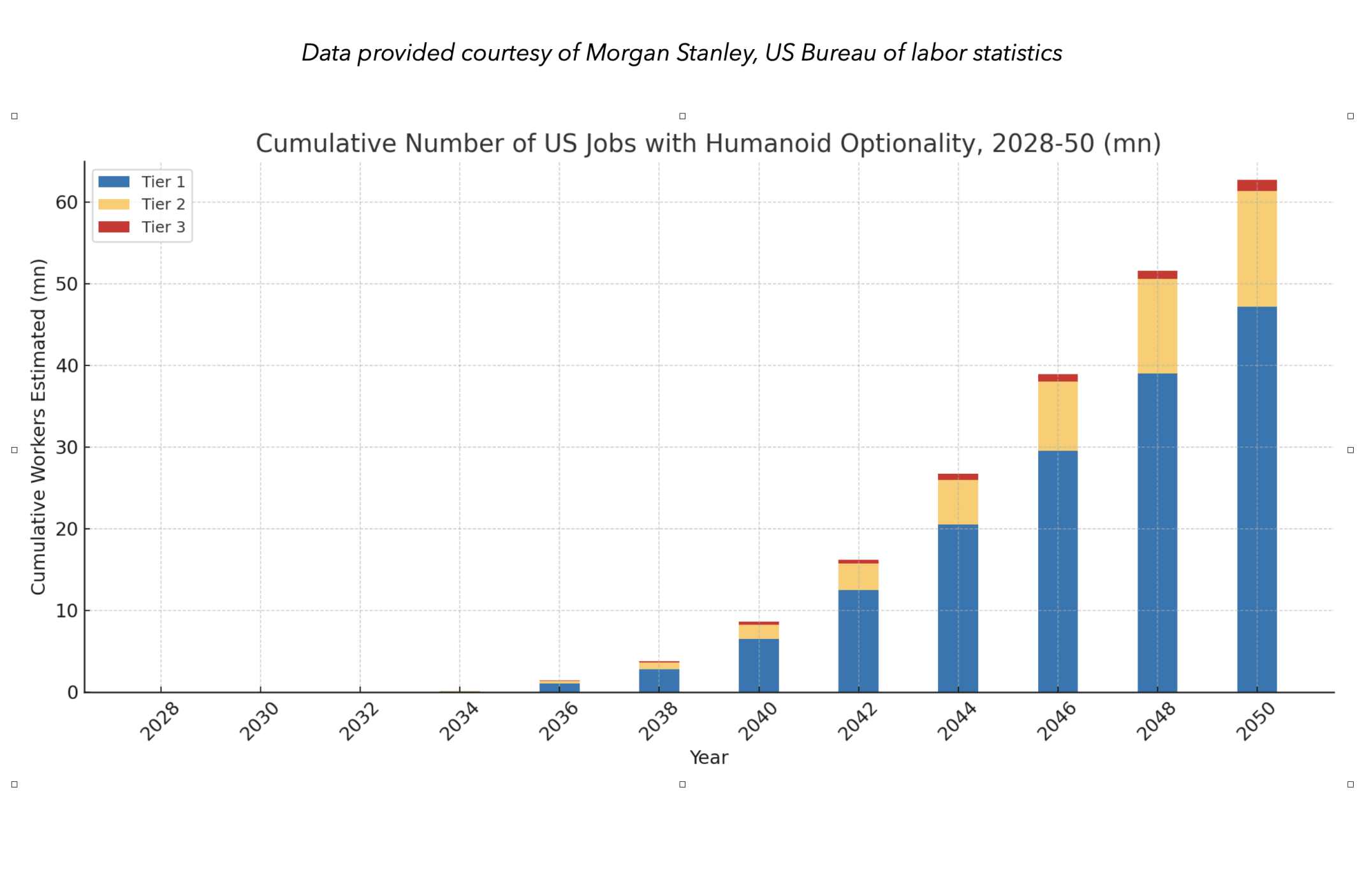
($5 trillion market by 2050; 62M US jobs transitioning)
Fortune
Business Insights
S&S
Insider
(USD 76.97B by 2032, 48.36% CAGR)
Additional reading:
MIT Technology
Review: The gig workers training humanoid robots (Apr 2026)
Rest of World:
Chinese data factories for robot training (Jan 2026)
Humanoid
Robot Market Size, Share, and Growth Analysis
Grand View
Research: Humanoid Robot Market Report
In private alpha - public beta coming soon
Check the FAQ